
AXLEHIRE
Last-mile driver delivery app
Flexible delivery scheduling with routes you choose.
Role - Founding Product Designer
Team - 5 engineers
Project Timeline - Design 2.5 weeks & Engineering 2 months
Summary
AxleHire’s driver app was struggling to scale as parcel volume and route complexity grew. Drivers faced slow pickups, inefficient handoffs, and unclear task flows, leading to delayed deliveries and operational strain. I led a full redesign of the mobile app to streamline high-volume operations and reduce friction in daily workflows to support our growing enterprise clientele and nationwide expansion.
Outcomes
Faster pickups, more efficient routes, higher accuracy, and a measurable lift in on-time delivery performance
~7%
Faster pickup times across high-volume routes
2.2
Minutes saved per stop, on average
98%
On-time delivery rate, sustained at scale
A system scalable enough to support multi-parcel workflows and growing demand

1. Context & Problem
As AxleHire expanded, the original driver app couldn’t keep up with increasing complexity:
Operational pain points:
-
Pickup processes were slow and error-prone
-
Drivers manually confirmed parcel IDs, creating bottlenecks
-
Drop-offs lacked parcel-level tracking
-
Visual hierarchy made it difficult to prioritize tasks
-
The app wasn’t built for multi-parcel, multi-stop workflows
Business pain points:
-
Needed a redesign that could be shipped incrementally
-
Must work seamlessly with warehouse workflows and dispatcher tools
-
Required to stay performant on older devices used by some drivers
The Goal
Build a scalable, intuitive, and high-efficiency mobile workflow that supports growing operational demands, reduces driver effort, and improves system-wide delivery performance.
2. Discovery & Insights
Through ride-alongs, driver interviews, analytics, and warehouse shadowing, I identified several critical insights:
Key Findings
-
Drivers were losing 20–30 seconds per parcel during ID confirmation (pickup & drop off)
-
Pickups often involved dozens of parcels but no bulk validation method
-
Manual entries caused data inaccuracies downstream
-
The UI forced drivers to jump between screens to complete a single task
-
Speed, clarity, and error reduction mattered more than aesthetics
These insights shaped the core design principles for the redesign.
3. Design Principles & Requirements
To support high-volume logistics operations, the solution needed to:
4. Key Designs
4.1. Streamlining High-Volume Pickups with QR Scanning
Before

Before
-
Drivers manually selected parcel IDs
-
Multi-parcel pickups took too long - increased driver frustration during busy hours
-
Increased chance of human error
After
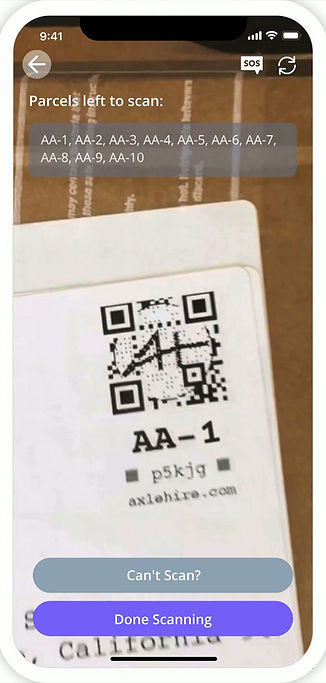
I introduced a bulk QR-based pickup system:
-
The scanning system auto-checks all parcels
-
UI confirms counts instantly with clear visual feedback
-
Reduces multi-parcel pickup time from minutes to seconds
After
Impact
Faster pickups
(7% improvement)
Higher operational accuracy
Reduced driver frustration during busy warehouse hours
4.2. Redesigning Drop-Offs for Parcel-Level Tracking
Before
-
Drop-offs tracked only stop-level activity
-
Drivers had to manually validate individual parcel delivery
-
Increased redundancy when drivers were not aware of multiple parcels for one shipment
-
Hard for support teams to troubleshoot disputes with duplicates
After
I reworked drop-off flows to support full parcel-level visibility:
-
Clear status for every parcel in each shipment
-
Easy confirmation screens
-
Parcel validation built into flow to ensure accuracy
-
Simplified hierarchy for multi-parcel stops
Before


This example shows how one delivery was duplicated across multiple entries. Drivers were forced to complete the same stop repeatedly, simply because each parcel was treated as a separate task.
After
![11. Shipment View [Post-Scan] 1.png](https://static.wixstatic.com/media/ed993a_cf46e2900d1f47038684eecb47098686~mv2.png/v1/fill/w_326,h_668,al_c,q_85,usm_0.66_1.00_0.01,enc_avif,quality_auto/11_%20Shipment%20View%20%5BPost-Scan%5D%201.png)
Parcels are consolidated into their proper delivery, streamlining the workflow and removing the confusing, repetitive steps.
Impact
Improved accuracy and transparency
Faster execution for drivers, eliminating redundancies
Stronger trust with partners & clients
4.3. Designing for Scalability
I restructured the entire app architecture to support future expansion:
-
Modularized task flows for easy iteration
-
Clearer navigation model
-
Reusable components for rapid development
-
Visual patterns aligned with AxleHire’s broader system
5. Final Outcome
The redesign transformed the driver experience into a faster, smarter, and more reliable workflow built for scale.
~7%
Faster pickup times across high-volume routes
2.2
Minutes saved per stop, on average
98%
On-time delivery rate, sustained at scale
Drivers adopted the new flows easily, reducing onboarding time
The new architecture became the core foundation for AxleHire's future product